Digital Learning: Children in the Nordics face the same challenges
Pedagogues and preschool teachers must develop children’s creativity and ability to create digital content themselves. It is a tough task, and therefore a number of universities, municipalities, folk high schools, pedagogue- and teacher educations, and preschools across all the Nordic countries have joined together.
By Joan Rask
Even young children must learn digitally. Simultaneously, they of course have to be creative, play, learn to talk, sing, and express themselves both analogically and digitally. Across the Nordic countries, pedagogues face the same challenge: The digital has to be a part of education – but how?
Anniqa Lagergren is a lecturer in pedagogy at Halmstad University in Sweden. She noticed the issue, got partners in the Nordic countries on board, and in 2015 established the network DILE (DIgital LEarning in preschools).
– The project is off to a good start, because it is formed of universities, educations, municipalities, and preschools. The students bring the new methods directly to the preschools, and that way the results spread like rings on water, says Anniqa Lagergren.
Even though the Nordic countries are often at the leading-edge of both the digital and the pedagogical concerning the very young children, there is barely any research on the topic yet. There are great distances between practical examples, and even larger distances among directions for teachers and pedagogues who want to get started. That DILE attempts to remedy.
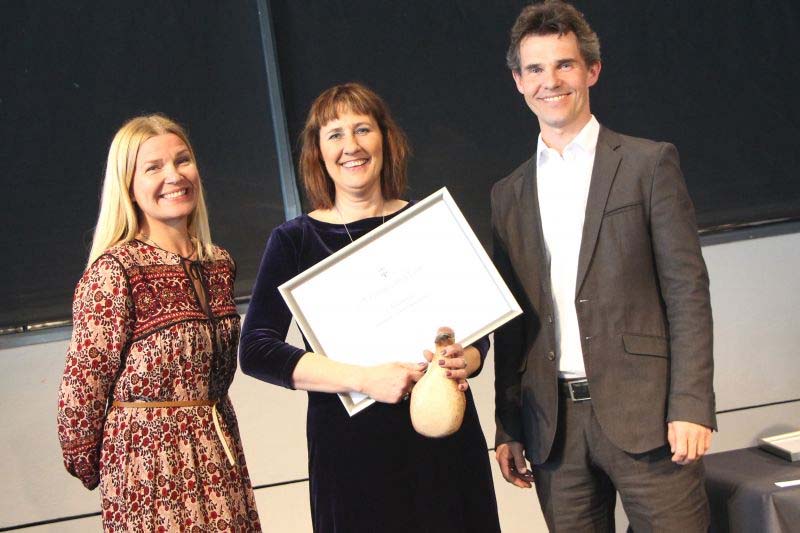
Ann-Margrét Ólafsdóttir (förskolechef förskolan Nóaborg) tog emot pris för projektet veckans barn. De som står bredvid är Skúli Helgason ledare för skolverket i Reykjavik og Eva Einarsdóttir er medlem av skolverket. Prisoverrækkelse for Nordplus-projektet DIL. Foto: Anniqa Lagergren
– Many pedagogues and teachers are unsure of what to do with the digital. It says in their curriculum that preschools must work digitally, but it is only valuable for the children if the digital activity is with, at the same time, both a pedagogical and a didactic purpose, says Anniqa Lagergren.
Parents are scared
It has taken Anniqa Lagergren by surprise that the parents are almost the greatest challenge.
– Parents are used to associating tablets with passive games and videos – that is, something which should be limited and kept from the children. Hence, we work on providing the pedagogues with arguments to explain the parents that we work pedagogically and didactically with the children, says Anniqa Lagergren.
That fear is shared by the Nordic parents. In Iceland, that is made clear by Svava Pétursdóttir, associate lecturer in education of young children and information technology at the teacher education at University of Iceland.
– Parents don’t want more mindless games on iPads. They have to be introduced to the idea of working with it in a creative and interactive way – and sometimes people are just not comfortable with IT, says Svava Pétursdóttir.
Her experience is what works best is to address the issue and take it seriously. In fact, there are many pedagogues and teachers opposed to IT and with a real concern about children spending too much time passively on IT. That is exactly why Svava Pétursdóttir has designed a blog in collaboration with colleagues, municipalities, and preschools in Iceland, which will accommodate all good (and bad) examples. It has recently been launched, but she hopes it will grow big during the next few years.
– In a perfect world, all the preschool teachers in the project would produce stories about what they do. Then everybody could see it, and we could spread it to more schools, says Svava Pétursdóttir.
She has namely often heard that when pedagogues and parents first see the concrete examples, and they themselves become comfortable with the technology, the fear dissipates.
The entire food chain has joined in
A strength of the network project is that all stakeholders from the education of young children are part of the network. Both Svava Pétursdóttir and Anniqa Lagergren highlight the importance of the municipalities’ administrations also being represented in close collaboration with the universities’ research units.
– If we continue, I would like to have a strong research focus. We need data about both the successes and what went wrong, says Svava Pétursdóttir.
So far, she is happy for what has already been achieved. As a specialist in both digital learning and education of young children, it was almost a gift to be invited to join the project. The first goal was to establish networks, accumulate knowledge, and test the methods with pedagogues and children. That goal has been reached, she thinks.
– Both the concrete examples in the preschools, and the research is important. There is a very short route. I teach my teacher-students something, and then they take it to the preschools, Svava Pétursdóttir says.
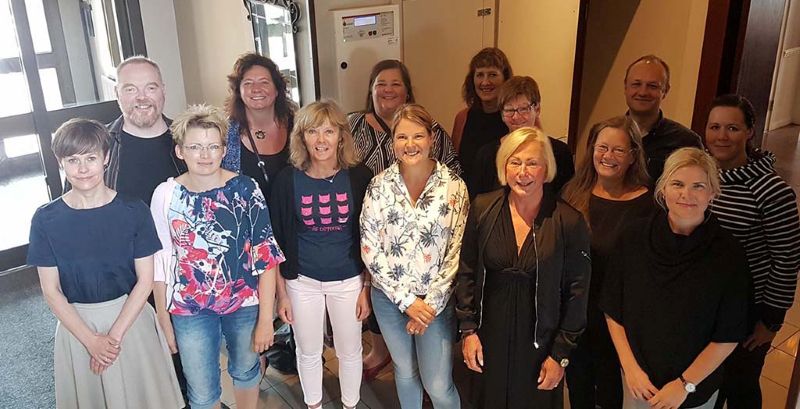
Participants in the Nordplus project "DILE - Digital Learning i Preschool". Photo: Anniqa Lagergren.
More information
The homepage: Digital Learning in Preschools
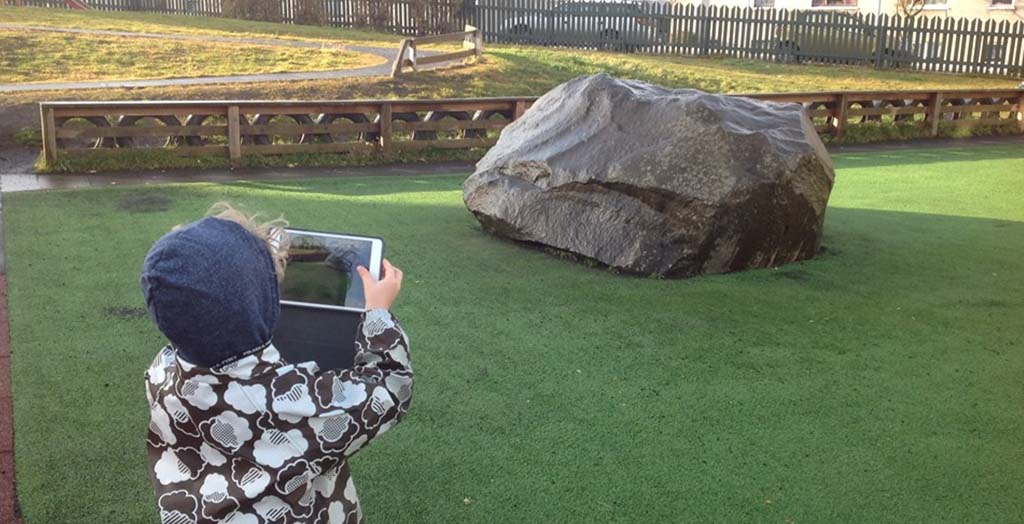
Picture at the top: A child participate in the project. Photo: Anniqa Lagergren
Coordinating institution
- Halmstad University
Partner institutions
- Varberg Municipality
- Telemark University College
- University of Iceland
- Kongsberg Municipality
- Aalborg University
- City of Reykjavik, Department of Education and Youth
- Åbo Akademi University
- Pedersore Kommun
Programme