About Nordplus
Nordplus is the largest educational grant programme funded by the Nordic Council of Ministers. Every year, Nordplus awards approximately EUR 11 million to organisations across the education sector in the Nordic and Baltic countries for international exchanges, networks, and other collaborative projects.
Target Groups
Nordplus is open to all organisations and institutions involved in learning and education in a Nordic or Baltic country. It is not possible to apply for funding as an individual. Organisations outside the Nordic-Baltic region cannot receive funding but may participate in projects at their own expense.
More information about the conditions for applying to and participating in Nordplus can be found under each sub-programme.
Five Sub-Programmes
Nordplus comprises five sub-programmes, which together cover all levels of education, from early childhood education and care, primary and secondary education, and upper secondary education to higher education and adult learning:
1. Nordplus Junior
2. Nordplus Higher Education
3. Nordplus Adult
4. Nordplus Horizontal
5. Nordplus Nordic Languages
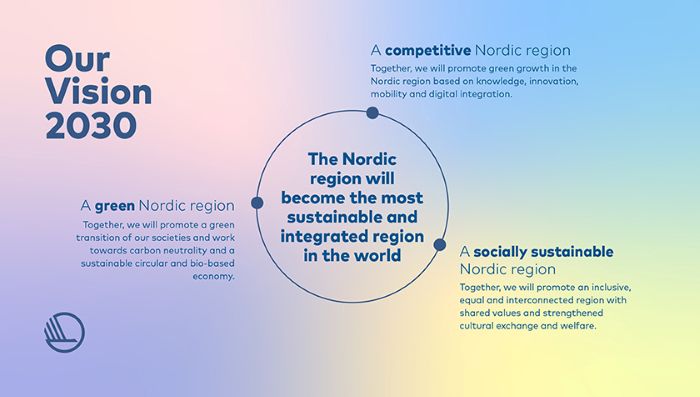
Vision 2030
The Nordic Council of Ministers’ vision, “The Nordic region will become the most sustainable and integrated region in the world”, is aligned with Agenda 2030 and the United Nations Sustainable Development Goals.
Highlight
In line with the Nordic Council of Ministers’ Vision 2030, Nordplus regularly introduces a highlight. Since 2025, the highlight is:
“Knowledge and Skills for a Competitive Nordic and Baltic Region”
A competitive region is a sustainable and equitable region that promotes education that responds to competence needs. The focus therefore includes strengthening basic skills in languages and mathematics, which are essential for educational success. Knowledge of STEM subjects, artificial intelligence (AI), and green competences is also important in maintaining global competitiveness.
Through mobility activities, individuals develop new skills, gain fresh perspectives, and experience other cultures. This, in turn, enhances their opportunities to enter the labour market and contribute to a sustainable society.
Nordplus highlight apply across all sub-programmes and are intended to encourage initiatives within specific themes. However, the higlight does not determine the content of new projects. The decisive factor in the approval of any project application is always its quality.
Goals for Nordplus
• To strengthen and develop Nordic-Baltic cooperation in education.
• To develop, exchange, and disseminate knowledge, experience, and good practice within the field of education.
• To contribute to quality development within lifelong learning systems through educational cooperation and partnerships with working life.
• To promote mobility for learning purposes and expand digital cooperation in education.
• To promote inclusive access to educational cooperation and opportunities for skills development through collaboration at organisational level.
• To promote Nordic languages and Nordic culture, and to strengthen mutual linguistic and cultural understanding between the Nordic and Baltic countries.
• To strengthen language comprehension, particularly between Danish, Norwegian, and Swedish.
• To stimulate interest in the societal languages of the Nordic countries (Danish, Faroese, Finnish, Greenlandic, Icelandic, Norwegian, Sámi languages, and Swedish), Nordic sign languages, and national minority languages.
The Nordplus Programme Committee
The Nordplus Programme Committee comprises 16 members from the relevant ministries of the participating countries. Members are appointed by the participating countries, with two representatives from each Nordic and Baltic country.
The Åland Islands, the Faroe Islands, and Greenland each participate with two observers.
The Nordplus Programme Committee decides on the allocation of funds within each sub-programme and is also responsible for the development of the individual sub-programmes and Nordplus as a whole.
If you would like to get in touch, please contact your national office.
Resposible Internationalisation
The rise in geopolitical tensions has affected international educational cooperation. Applicants are encouraged to ensure that international collaborations are conducted in a secure and ethically responsible manner.
This aspect is not formally assessed by the Nordplus administration. However, applicants are encouraged to consult relevant guidelines and recommendations on responsible internationalisation.
More about Nordplus
Follow us on social media 
