Upper secondary students explore the Nordic region’s minority languages
Swedish and Finnish upper secondary school students have gained a new perspective on the cultures and languages that are often overlooked in Sweden and Finland. At the same time, they met up in person and jointly developed an interactive map of minority languages in the Nordic region.
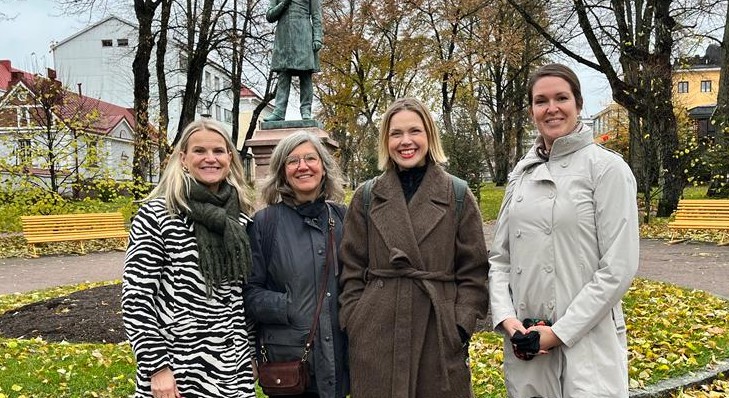
By Joan Rask, Journalist
Upper secondary school students generally know far too little about the minority languages of Sweden and Finland. Three language teachers were in agreement about this when they happened to meet in Denmark at a Nordic seminar. One was Swedish and the other two were Finnish. One of them was Satu Skogster, who is now vice principal at Helsinki Upper Secondary School of Language and from August, she will be the principal.
- We all wanted to show our students that the Nordic region is also home to minority languages and cultures that few people know about. It was important to us that they saw this diversity,” she says.
According to Satu Skogster, this became the starting point for the Nordplus project “Minority Languages in Sweden and Finland”, which set out to both develop an interactive map and to teach students about minority languages.
Finnish and Finland Swedish are spoken in Sweden and Finland, and the Sámi languages are spoken in both Sweden and Finland – but can they understand one another? These are questions that very few young people can answer, and that needs to change, according to Satu Skogster.
- Many people do not think about the fact that there is a large Swedish-speaking minority in Finland. And in Sweden, people often ask me: How come you speak Swedish so well?” says Satu Skogster, who is herself part of the Swedish-speaking minority in Finland.
Meeting in person works well
An important element of the new collaboration was that the teachers received Nordplus funding to prepare the project.
- It is difficult to develop ideas in a busy working day. It worked much better when we were sitting down together. That opportunity made a big difference to us,” says Satu Skogster.
The final evaluation shows that the teachers were satisfied, that the objectives were achieved, and that there was plenty of shared Nordic dialogue and social interaction. The evaluation also highlights that developing a website was inspiring for the language teachers. But the students were also pleased, she says.
- It was fun to see how keen the Gothenburg students were to learn and to come to Finland,” says the vice principal.
She explains that, for many students, the trip would have been impossible without financial support, and that many students said they would never have had such an experience on a family holiday.
- The students were very grateful. It meant a lot for them to get to know one another. It worked because they went to each other’s lessons, cooked, went shopping and played games,” she says.
For Satu Skogster, the experience was also valuable.
- As a group, we created something quite unique. It is valuable to experience how similar and yet different the Nordic countries are. It is almost like seeing yourself in the mirror from another angle,” she says.
Satu Skogster would have liked to continue the network, but unfortunately the Swedish coordinator is now working abroad, so it is uncertain whether the partner group will continue.
- I can highly recommend taking part in Nordic projects. If anyone is interested, I am always open to it,” says Satu Skogster.
Facts
Nordplus Junior: Minority Languages in Sweden and Finland
The upper secondary school students were in their second year. The project was made possible because the Swedish students were able to include the production of the website as part of their curriculum.
NB:
The interactive map of minority languages is no longer publicly available online. A solution is being worked on, but it is uncertain whether this will be possible.
Coordinating institution:
• Lerums gymnasium, Sweden
Partner institutions:
• Helsingin kielilukio, Helsinki Upper Secondary School of Languages, Finland
• Linnankosken lukio, Finland